


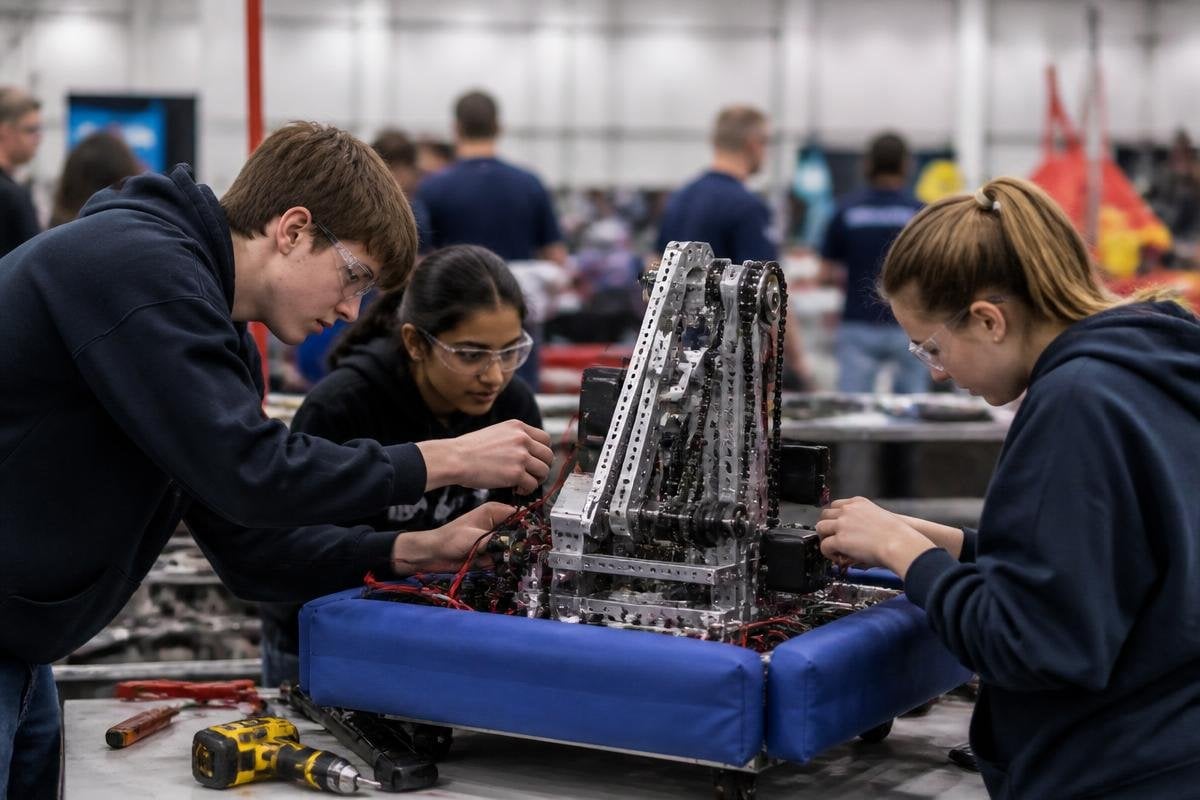
A robotics competition turns a blank workbench into a clear engineering problem: build a robot, run it under rules, and earn points for what it does. That structure can draw new engineers toward mechanical design, electronics, software, and control because each choice produces a visible result.
- A fixed task gives beginners a place to start
- Testing links code and hardware to a score
- Failure becomes information for the next run
A robot gives theory a job
A lesson about torque can feel distant until a motor fails to lift an arm. A sensor diagram matters more when the robot must detect an object before it reaches the wrong place. The competition gives each technical idea a job to do.
That job makes progress easier to see. A team changes the gear ratio, adjusts the motor command, or moves a sensor, then runs the robot again. The result may be a faster turn, a cleaner stop, or a missed target. Students can connect the change they made with the behavior they saw.
The work also crosses several parts of engineering at once. A robot may need a frame that stays stiff, wiring that survives movement, code that reads sensors, and a control loop that tells the motors what to do.
Those parts affect one another, so the team learns to check the whole system instead of treating each part as a separate school task.
Rules create useful limits
A competition usually gives teams a task, a playing area, and a set of limits. The robot may have a size limit, a fixed start position, or a restricted set of parts. These limits force choices about weight, battery power, grip, speed, and repair time.
That pressure resembles engineering work more closely than an open project does. A team can’t build every idea, so it has to decide what the robot must do first. A design that performs one task every time may score better than a larger design that tries several tasks and fails halfway through.
The score also gives teams a shared test. Instead of arguing about which design looks better, they can compare completed tasks, penalties, run time, or points. The measure is imperfect, but it gives a young engineer a reason to record results and change one part at a time.
Failure becomes part of the work
Robots fail in ways that are easy to see. A wheel slips. A cable pulls loose. The code reads a dark surface as an object. A gripper reaches the target but drops it during the turn.
Those failures can feel less personal because the machine is the thing being checked. The team can inspect the motor, sensor, code, or frame and try again. That habit matters later, when a design review or test run exposes a fault that no drawing predicted.
A competition also gives a team a deadline. With limited time before a run, members must choose between adding a new function and fixing a known fault. That choice teaches planning without turning planning into a separate lesson. The clock makes the trade-off visible.
A contest task feels less abstract when students can compare it with robots used beyond school. Robot24.com’s robotics coverage reports on machines and automated systems, giving teams a way to connect a design choice with work outside the contest floor. That habit carries into the next lesson: engineering is shared work.
Teams learn how engineers work
A robot needs more work than one person can finish well in a short build period. One student may write code while another checks the drive system, and someone else may record test results or repair the frame. The work changes as the robot moves from design to testing.
That division creates useful habits. Team members must explain a choice, label a change, and leave enough information for someone else to continue the work. They also learn that a good idea has to fit the wiring, software, budget, and time available.
The opposing view deserves a place here: contests can reward speed and scoring over careful design. That risk is real when a team copies a known build without understanding it. A well-run contest counters the problem by asking students to explain their choices and inspect their own results.
I’d send a beginner to a small robotics contest before giving them a long, open-ended build brief.
A practical starting checklist
Use these checks before choosing a competition or forming a team:
- Read the full scoring rules and size limits.
- Pick one task the robot can repeat during early tests.
- Set aside time for wiring checks and battery charging.
- Record each run, including the fault that stopped it.
- Give every team member a clear job, then rotate jobs.
- Leave time to repair the design after the first scored run.
The best result may be a higher score, but the lasting gain is a working habit: define the task, build a test, inspect the failure, and make one measured change. A student who leaves with that habit has a useful next project waiting on the workbench.
